
Polish Resettlement Corps (PRC)
When, in July 1945, the British government withdrew recognition of the Polish Government in London to recognise the Warsaw regime imposed by Russia and refused Polish forces a place in the Victory parade, it found itself with a very tricky problem – what to do with a large allied army, air force and navy owing its allegiance to, and under the control of, a government no longer recognised by the British and actively hostile to the government now proclaimed by Britain and the USA as the legitimate government of Poland?
One of the options was to repatriate the Polish armed forces and their dependents forcibly to Poland but, as it is succinctly put in a cabinet briefing paper “… it needs to be born in mind that the Polish army is currently the largest fighting force in Italy.” The problem was solved in a pragmatic and very British way. A Polish Resettlement Corps (PRC) was raised in 1946 by the British government, as a corps of the British Army, into which Poles were enlisted for the period of their demobilisation – which would be completed by 1949.
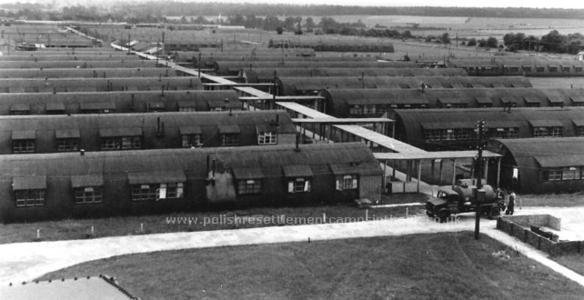
At one end of the camp were clusters of huts built on concrete bases with
walls of timber with metal sheeting and corrugated asbestos roofs
Some 150,000 chose to remain in Britain and were joined later by their families and dependents from wherever the fortunes of war had left them, swelling the numbers to well over 200,000. The only way such numbers of men and their families could be accommodated was by placing them in camps recently vacated by the Americans and Canadians. Some 265 camps were occupied by the PRC; most were built in the early 1940s in rural areas, often in the grounds of large country estates, as Military Hospitals, Army Bases and Airfields. There were also a small number of short-lived temporary camps under canvas.
Members of the PRC were enlisted for a period of two years but all were registered with local labour exchanges (job centres) as available for work, to be demobilised in regional PRC Administration and Payroll centres as soon as they found employment. The main centre was in Witley Camp in Surrey and people often wonder why this camp is mentioned even though they never actually lived there. This stamp is their demobilisation stamp.
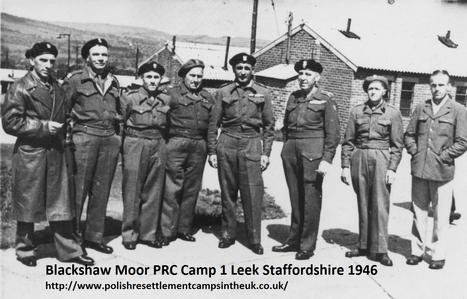
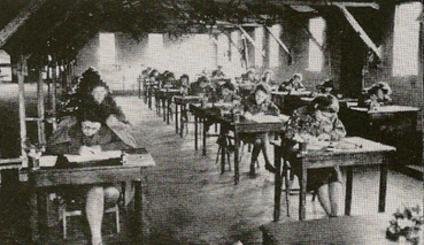
The PRC was a uniformed but unarmed formation, with the specific task of preparing its members for civilian life in Britain and training them to work in sectors of the British economy that were suffering from a shortage of manpower, such as mining, construction, heavy industry and agriculture. It operated under British law and was subject to King’s Regulations but retained its Polish military organisational structure and was commanded by Polish officers.
In practice, there were a number of obstacles to taking up civilian work. Industrial areas short of manpower were often also short of living accommodation. The National Service Hostels Corporation (NSHC) often helped in these cases by setting up hostels for single working men but these were very primitive and quite unsuitable for families. Trade unions were jealously protecting skilled jobs and in many cases would not recognise vocational training provided in the PRC, and so only the most menial work could be offered to the Poles. Many labour exchanges operated a semi-official policy of jobs for British workers first, and so personal contact became a major source of job opportunities. Companies that had employed Poles and found them to be hard-working and reliable would encourage them to spread the word among their Polish friends that there was work to be had and this led to Polish communities being established in these areas.
The PRC completed its mission and was disbanded in 1949.
POLISH 2nd CORPS UNITS ASSIGNED TO RESETTLEMENT CAMPS IN THE UK
The War Office formed a plan for the dispersal of Polish displaced persons upon their arrival in Britain from Italy. Soldiers were to be distributed across the various Commands in Britain… the exception being Scotland. Most of 1st Corps were based there and it was felt that a further influx of Poles would antagonize the local population. Even so, 4,640 were sent there regardless. Where the Poles ended up and eventually settled largely depended on luck and to which unit they belonged. Initially they were housed in vacated barracks (often US or Canadian) before being demobilised into the Polish Resettlement Corps.
Civilians were allocated to hostels, schools and resettlement camps.
There was only marginal migration from these first settlement areas and most of that happened when sufficient accommodation and work became available. Certainly, the big cities drew many and they became visible communities, but there remained a huge, widely dispersed Polish community in rural Britain.
Polish 2nd Corps Units Assigned to Resettlement Camps in the UK
| SCOTTISH COMMAND | EASTERN COMMAND | |||
| Base Troops | HQ 3rd Infantry Division | |||
| HQ Artillery Group | 3rd Infantry Division | |||
| Berwickshire | 1930 | HQ 14th Armoured Brigade | ||
| Roxburghshire | 1880 | 14th Armoured Brigade | ||
| Berwickshire | 830 | Buckinghamshire | 4,970 | |
| 4640 | Hertfordshire | 860 | ||
| Huntingdonshire | 200 | |||
| NORTHERN COMMAND | Norfolk | 12,850 | ||
| HQ 2nd Armd Division | Suffolk | 650 | ||
| 2nd Armoured Division | Sussex | 3,760 | ||
| Derbyshire | 580 | 23,290 | ||
| Lincolnshire | 5730 | |||
| Northumberland | 5080 | WESTERN COMMAND | ||
| Yorkshire | 4780 | HQ 2 Polcorps & Base Troops | ||
| 16,170 | Anglesey | 3,560 | ||
| Brecon | 1,450 | |||
| SOUTHERN COMMAND | Cheshire | 1,330 | ||
| HQ 5th Inf Div. (5KDP) | Cumberland | 26,850 | ||
| 5th Infantry Division | Derby | 840 | ||
| Berkshire | 1,200 | Glamorgan | 1,850 | |
| Gloucestershire | 4,720 | Hereford | 7,260 | |
| Oxfordshire | 3,530 | Lancashire | 6,790 | |
| Wiltshire | 6540 | Merioneth | 490 | |
| 15,990 | Montgomeryshire | 1,730 | ||
| Pembroke | 2,060 | |||
| Shropshire | 1,240 | |||
| Stafford | 5,100 | |||
| Yorkshire | 170 | |||
| TOTAL TROOPS: 120,810 | 60,720 | |||
| [Public Records Office FO371 56388 N8991] | ||||
List of Resettlement Camps in the UK
| Name of Camp / Hostel / School | County in UK | Years of Operation | Year Closed | |
| 1 | Ashby Folville Camp | Leicestershire | 1956/1957 | |
| 2 | Babdown Camp | Gloucestershire | 1948-1959 | 1959 |
| 3 | Blackshaw Moor Camp | Staffordshire | 1947-1961 | 1961 |
| 4 | Bower Wood Camp | Beaconsfield Buckinghamshire | ||
| 5 | Breighton Airfield Camp | North Yorkshire | ||
| 6 | Burlington Crossing Camp | Stourport | ||
| 7 | Carr Lane Camp | Hull | ||
| 8 | Checkendon Camp | Berkshire | 1948-1961 | 1961 |
| 9 | Daglingworth Camp | Gloucestershire | ||
| 10 | Damfield Lane / Maghull Camp | Liverpool Transit camp | ||
| 11 | Delamere Park Camp | Northwich | 1949-1963 | 1963 |
| 12 | Diddington Park School | Huntingdonshire | ||
| 13 | Doddington Camp | Cheshire (near Crewe) | 1960/1961 | |
| 14 | East Moor Camp | Yorkshire | 1948/9-1959 | 1959 |
| 15 | Elsham Wolds Camp | Lincolnshire | 1948 to 1953 | 1953 |
| 16 | Fairford Camp | Gloucestershire | by 1959 | |
| 17 | Foxley Camp | Herefordshire | 1955 | |
| 18 | Great Missenden Woodlands Park Camp | Buckinghamshire | 1956 | |
| 19 | Grove Park Camp | Buckinghamshire, (near Iver), | 1957 | |
| 20 | Hallburn Hostel | Cumbria (near Longtown) | 1947-1953/54 | by 1954 |
| 21 | Hardwick Park Camp | Chesterfield | 1947-1955 | 1955 |
| 22 | Haydon Park Camp | Somerset | 1955/1956 | |
| 23 | Hazlemere Camp | Buckinghamshire (near High Wycombe) | 1948-1955/56 | 1955/1956 |
| 24 | Hiltingbury Camp | Hampshire (near Southampton) | 1946-1956/57 | 1956/1957 |
| 25 | Hodgemoor Camp | Buckinghamshire (near Amersham) | 1947-1959 | 1959 |
| 26 | Hucknall Camp | Nottinghamshire | ||
| 27 | Husbands Bosworth Camp | Leicestershire | ||
| 28 | Illford Park Camp | Devon (near Stover) | ||
| 29 | Keevil Camp | Wiltshire | 1949-1957/58 | 1957/1958 |
| 30 | Kelstern Airfield Camp | Lincolnshire | ||
| 31 | Kelvedon Camp | Essex | 1949-1958/59 | by 1959 |
| 32 | Lilford School | Northamptonshire | ||
| 33 | Long Marston Camp | Warwickshire | 1948 – 1968 | 1968 |
| 34 | Lowther Park Camp | Cumbria (near Penrith) | 1948-1955/56 | by 1956 |
| 35 | Ludford Magna Camp | Lincolnshire | 1940-1955/56 | by 1956 |
| 36 | Lulsgate Camp | Bottom near Bristol | ||
| 37 | Market Harborough / Lubbenham Camp | Leicestershire | ||
| 38 | Marsworth Camp | Hertfordshire (near Dunstable) | 1947-1960/61 | 1960/61 |
| 39 | Melton Mowbray Camp | Leicestershire | 1947-1961/62 | 1958 |
| 40 | Mepal Camp | Cambridgeshire | 1948-1958 | by 1962 |
| 41 | Morpeth Common Camp | Northumberland | 1947-1962 | 1962 |
| 42 | Nettlebed H o s t e l | Oxfordshire | 1947 – 1955 | 1955 |
| 43 | Northwick Park Camp | Gloucestershire | 1947-1970 | 1970 |
| 44 | Penley Camp | North Wales | 1946 – 2002 | 2002 |
| 45 | Penrhos Camp North Wales | North Wales | ||
| 46 | Perton H o s t e l | Wolverhampton | ||
| 47 | Petworth Camp | West Susex | ||
| 48 | Podington Camp | Bedfordshire | 1948-1956 | 1956 |
| 49 | Redcar Camp | North Yorkshire | ||
| 50 | Seighford Camp | Staffordshire | ||
| 51 | Southrop Camp | Gloucestershire | ||
| 52 | Springhill Lodges Camp | Gloucestershire | 1947-1958 | 1958 |
| 53 | St Mawgan Camp | Cornwall | 1947-1951 | 1951 |
| 54 | Stowell Park School | Gloucestershire | ||
| 55 | Sturgate Airfield Camp | Lincoln | ||
| 56 | Tilstock Higher Heath Camp | Shropshire | 1947-late 1950s | late 1950s |
| 57 | Tweedsmuir Camp | Surrey | ||
| 58 | Weeting Hall Camp | Norfolk | 1949-1955 | 1955 |
| 59 | Wheaton Aston | Staffordshire | 1965/1966 | |
| 60 | Wrothesley Camp | Wolverhanpton |
Read more about the camps at Zosia Biegus’s excellent and very informative site, which also includes passenger lists of ships: http://www.polishresettlementcampsintheuk.co.uk/
and more information here
https://culture.pl/en/article/shelter-community-polish-post-war-resettlement-camps-in-the-united-kingdom
KELVEDON CAMP SNAPSHOTS by Jerry Kubica: Growing up in a Polish Resettlement camp 1947-57