
The Political Reality post 1945
British View of the Polish Armed Forces
The British military leadership and soldiers deeply respected the Polish Armed Forces. The Polish ll Corps under the command of General Anders had fought bravely and effectively and most famously in the Battle of Monte Cassino in 1944, playing a crucial role in the Allied advance in Italy. British generals, including Field Marshal Alexander, praised their contributions.
However, in July 1945, Britain recognised the Soviet-backed Provisional Government of Poland (the Lublin Committee) effectively abandoning the Polish Government-in-Exile based in London to which the II Corps had sworn allegiance. At that time there were approximately 600,000 Poles left stranded in the west including those of the Polish Armed Forces, the Polish civilians who travelled with General Anders Army, children from camps in India and Africa, political and cultural refugees, those from German concentration camps, forced labour camps and prisoners of war camps including those who surrendered after the Warsaw Uprising.
The British politicians held mixed views about the fate of Poles in exile but both Conservative and Labour Governments in the summer of 1945 pursued a policy of repatriation.. The Foreign Secretary, Anthony Eden wrote to James F. Byrnes American Secretary of State on 17 July 1945 on the subject of the “Polish question” saying:-
Finally, they (the three Powers) are anxious to assist the Polish Provisional Government in facilitating the orderly return to Poland as soon as practicable of all Poles abroad who wish to go; the Polish Provisional Government could itself greatly assist in this task by giving specific undertakings that those Poles who return will do so with full assurance of their personal security, freedom and livelihood.”
Following the General Election in July 1945 and the change of Government, the new Foreign Secretary Ernest Bevin followed a similar line. In a speech in Parliament on 20 August he said
Then there are the Polish troops and civilians in Western Europe. Thousands of Poles are outside Poland, either in the Services or working. The number of Poles in Field-Marshal Mongomery’s zone alone to be repatriated is 550,000………
I would urge Poles overseas, both military and civilian, to go back to their country and assume their responsibilities in building the new Poland. They will render a far greater service there than they can do from outside.
Hansard record of Parliamentary Debate 24 August 1945
A Parliamentary debate on Poland was held on 24 August 1945 where sympathy for the exiles was expressed. However, this was not universal. At that time Mr. Hector McNeil Labour Under-Secretary of State for Foreign Affairs and MP for Greenock expressed his view.
The Foreign Secretary, in his speech of 20th August, asked all Poles abroad to return and take their share in that responsibility and in that way. We hope that, very shortly, we will have started the flow of Poles from this country back to their own.We are optimistic that with the consent of the parties interested we may, within a very few weeks, have started the return of Poles who wish to return from Field-Marshal Montgomery’s zone, and I very much dislike what I thought were rather irresponsible figures quoted by the hon. and gallant Gentleman. These Poles are going to take their share in running their country, and there is a great urgency for them. We hope very shortly the Provisional Government will give us facilities for sending observers into the territory which they now administer. We know a little about it already. This House, which has always listened this week gravely and not without emotion to Members pointing to what may happen in Europe from hunger and disease during this oncoming winter, will be impressed if I tell them that in Western Poland just now we know there are crops which cannot be garnered unless we get the man power back there quickly. We are going to do what we can. We are being backed by the Provisional Government, which is displaying great energy and imagination in the re-start of the economic life which lies in their control. I do plead earnestly with every one who is truly a friend of the Poles—and I would be impertinent if I suggested otherwise than that the three hon. Members to whom we are indebted for this discussion are not real friends of the Poles—and all who think of themselves in that way that they must band themselves to see that those Polish men and women who want to go back to their homes and their country are given every inducement to do so. We can help in recreating a healthy Poland, and we will, so will every nation in Europe, and so will everyone of the United Nations, but we cannot have a healthy and restored Poland without the Poles themselves to do the job.
Hansard record of Parliamentary Debate 24 August 1945
By March 1946, Government policy shifted and created the Polish Resettlement Corps to help those who wished to remain in Exile.
In 1947, Britain passed the Polish Resettlement Act, allowing around 120,000 Polish soldiers and their families in settlements in Africa and India to settle in the UK — the first large wave of non-Commonwealth immigration.
This was a pragmatic and humane response, though tinged with political awkwardness, as it implicitly acknowledged a betrayal of a key wartime ally.
PolishGovernment-in-Exile’s View:
The Polish Government-in-Exile in London viewed the Polish II Corps in Italy with immense pride, deep loyalty, and symbolic significance—it saw the Corps as a crucial representation of legitimate, sovereign Polish armed resistance during World War II. General Władysław Anders, the Corps’ commander, took orders from the Government-in-Exile and was one of its most trusted military leaders. The Corps symbolised continuity of Polish sovereignty and military tradition, even as the homeland was under German and Soviet occupation.
The Government-in-Exile regarded the Corps as embodying the “true Poland”—democratic, Western-aligned, and anti-totalitarian. Their performance in Italy, especially at Monte Cassino, was celebrated as a vindication of Polish honour and sacrifice on the world stage. The Corps was also a reminder to the Allies of Poland’s contribution to the Allied victory and a moral argument for Poland’s independence postwar.
However, on 22 February 1944, Winston Churchill made a statement to the House of Commons saying:-
Russia naturally has very definite views as regards her frontiers and, if the rectification of frontiers can guarantee peace in Europe, in God’s name let us rectify them. But the rectification must take place by agreement and not by force. I do not think that we can do other than say that, so far as Poland is concerned, we must agree to the Curzon line provided that concessions are made in other directions which would recompense Poland for territories that she will have lost in the East. I am more than a little anxious about our foreign policy. Was the foreign policy enunciated by the Foreign Secretary at Moscow in all respects the same as the foreign policy agreed upon between the Prime Minister and Marshal Stalin at Teheran? If relations there were so cordial, then why did Soviet Russia administer such a slap in the face to us and to the United States when we sought to help in solving the Polish difficulty, because after all we are deeply concerned in the affairs of Poland.
Hansard col. 712 , 22 February 1944
General Władysław Anders, Commander of the Polish II Corps and a key figure in the Polish government-in-exile was preparing his troops for battle in Italy. He described this event in his book Army In Exile as follows
The speech was a new and heavy blow to us, as, for the first time, after referring to the past in a manner not quite exact, he said that British views on Poland’s eastern frontiers took shape in the so called Curzon line – a line which had never been considered as a state boundary, but was only proposed in 1920 as a demarcation line in case of an armistice. There has been no mention of a Curzon Line when Great Britain signed her alliance with us in 1939, nor was the Curzon Line ever mentioned when we fought alone in that year. Our eastern frontiers were not questioned when our soldiers fought in France in 1940, or our airmen over London. Churchill’s speech greatly depressed our soldiers, most of whom had home and families eats of that line.
He believed that Poland was being sacrificed to appease Stalin, despite its substantial military contribution to the Allied war effort. “Poland, for whose liberty the war was begun, has now been betrayed into slavery.” — a paraphrased sentiment common among Anders and Polish officials post-Yalta. Anders strongly opposed the idea of returning to a Soviet-controlled Poland, arguing that it would lead to the oppression and persecution of anti-communist Poles and former resistance fighters. He also discouraged members of the Polish Armed Forces in the West from returning, knowing they risked arrest or worse. As head of a major Polish military force that fought valiantly at Monte Cassino, Anders was outraged that Stalin’s regime—which had committed atrocities like the Katyn massacre—was being rewarded. He considered the Soviet-backed Lublin Committee illegitimate and rejected the idea of it replacing the London-based Polish government-in-exile. As Britain and the U.S. shifted recognition to the Soviet-backed Lublin Government in 1945, the Government-in-Exile saw this as a deep betrayal. The II Corps became a political orphan: a loyal army without a country, since the government it served was no longer recognised. The Government-in-Exile encouraged the Corps not to return to Poland, warning that many would face persecution or execution under the communist regime.
Italy
The Polish II Corps, under the command of the British Army, had fought with distinction in the Italian Campaign but despite their valour, the soldiers became displaced refugees at the end of the war. Poland was under Soviet control following agreements at Yalta, which prevented many Polish soldiers from returning home safely.
The Italian government and people were generally friendly toward the Polish troops during the war, and many Polish soldiers were buried in Italy, such as at the Monte Cassino Polish War Cemetery and in other locations like Casamassima and Bologna.
After the final battles in Italy, including the capture of Bologna in April 1945, the Polish II Corps remained near Ancona for some time. A Polish communist Military Mission was set up in Italy to encourage Polish soldiers to return to Poland. The Communists urged the soldiers to return so that they could take part in the promised free elections that were to take place but also threatened that those who decided not to return ran the risk of losing their Polish citizenshipmeaning they might never be able to return.
By mid-1946, the British government arranged for the Polish II Corps to leave Italy and be transported to England and Scotland. The soldiers were transported primarily by ship through the port of Naples and also by train through Germany and France to Great Britain.
Dilemma: Choosing Exile
The cause of the Polish Armed Forces had been to free their homeland by continuing to battle north from Italy across Europe back to Poland. Whilst in Italy and on arrival in Britain, they and their families faced a dilemma whether to make a new life in exile in foreign countries or return to their homeland and possibly face repression or death.
Many were from Kresy in eastern Poland, which had been subsumed into the USSR as agreed at the Yalta summit. Their homes had been appropriated or destroyed by the same enemy regime that had deported them to Siberia in 1939.
Those who decided to stay in the West hoped for a future free Poland. There were two rival Polish governments: the Polish government-in-exile, based in London (anti-communist, supported by many Polish forces in the West) and the Provisional Government of National Unity, a Soviet-backed communist regime in Warsaw. Many Polish soldiers in the West had been loyal to the government-in-exile and had fought under British command in campaigns like tyhe Battle of Britain, Monte Cassino, Normandy, and Arnhem. Many soldiers had experienced Soviet deportations, arrests, and labour camps before joining the Polish II Corps, making them deeply distrustful of the Soviet-backed regime in Poland.
Whilst life in exile in a foreign land may have been daunting, the British government in recognition of a debt for their service, established the Polish Resettlement Corps to help Polish soldiers transition to civilian life in Britain or other Commonwealth countries, offering an alternative to returning to communist Poland
Dilemma: Choosing To Return
Many of the soldiers who chose to return were from regions such as Pomorze, Wielkopolska, and Śląsk which had been incorporated into Nazi Germany during the war. These soldiers had been forcibly conscripted into the German Wehrmacht and were familiar primarily with German occupation rather than Soviet control. Their family homes remained in Poland, and their families were waiting for them, which motivated their return. Some soldiers hoped to help rebuild their homeland after the war, responding to calls from British and Polish authorities encouraging repatriation to assist in Poland’s reconstruction. A smaller number of soldiers believed in the possibility of free elections and a democratic future in Poland and took part in underground resistance despite the communist government imposed by the Soviet Union.
The Soviet-backed Polish communist government initially encouraged soldiers to return, promising them a place in rebuilding Poland. Propaganda portrayed returning soldiers as heroes and patriots — but this was often a deceptive tactic to identify and control potential opposition. Returning soldiers were told to congregate at a camp in Cervinara, near Naples. Approximately 14,000 regulars as well as a few officers opted to return.
Those Polish soldiers who did return to Poland after World War II often faced a harsh and tragic reality. Some were allowed to reintegrate into society. Returning soldiers were viewed with deep suspicion, especially those who had fought under Western Allied command (e.g., in the UK, Italy, or France). Many were interrogated by the UB (Urząd Bezpieczeństwa) — the Polish communist secret police — and kept under constant surveillance. Thousands were arrested, often accused of being spies, agents of the West, enemies of the people. Many were sent to prisons or labour camps in Poland, and some were even deported to the Gulag system in the USSR. Those not imprisoned often faced discrimination in jobs, education, and housing. Many were blacklisted and forced into menial labor or denied professional advancement. Their military service in the West was erased or vilified, and history books omitted or distorted their roles. Some returned soldiers lived quietly, hiding their past, avoiding attention, and trying to survive under the regime. Veteran organisations were suppressed and open commemoration of Western Polish forces was forbidden until the late 1980s. After the fall of communism in 1989, many of these soldiers were posthumously exonerated and honoured. Memorials, museums, and documentaries have helped restore their reputations, and their roles are now recognised as vital parts of Polish history.
The most famous case is the Trial of the Sixteen held by Soviet authorities in Moscow in June 1945 against sixteen leaders of the Polish Underground State, including key figures such as General Leopold Okulicki, Jan Stanisław Jankowski, and Kazimierz Pużak. These leaders had been invited to a conference in Pruszków in late March 1945, where they were promised safe conduct but were instead arrested by the NKVD, brutally beaten, and deported to Moscow for interrogation and torture in the Lubyanka prison. The accused were charged with fabricated crimes including collaboration with Nazi Germany, espionage, sabotage behind Soviet lines, state terrorism, planning a military alliance with the Nazis, possession of illegal radio transmitters and weapons, propaganda against the Soviet Union, and membership in underground organisations.
The accused were charged with fabricated crimes including collaboration with Nazi Germany, espionage, sabotage behind Soviet lines, state terrorism, planning a military alliance with the Nazis, possession of illegal radio transmitters and weapons, propaganda against the Soviet Union, and membership in underground organisations.
The Polish government-in-exile protested the arrests and trial to Western Allies, but the United States and Britain tacitly accepted the Soviet actions, ultimately withdrawing support from the legitimate Polish government-in-exile shortly after the trial. The trial symbolised the betrayal of Poland by the Allied powers and marked the beginning of Soviet domination and repression of the Polish nation, with many former underground members hunted by communist authorities in the following decades.
In the Parliamentary Debate on 24 August 1945 about the situation in Poland, Professor Savory of Queen’s University, Belfast, reported
On 24th July, Reuter’s despatch, published in this country, reported that 300 people were condemned by a special court in Warsaw for “treason against the Polish nation,” and that 6,000 more cases were pending. On 18th August, Warsaw radio gave another item which developed this information by saying that “1,692 new cases of treason against the Polish nation were opened before a special tribunal in Warsaw last month.
Hansard 1124, 24 August 1945
Notable Returnees
Captain Witold Pilecki
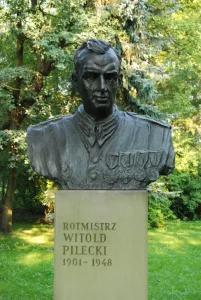
Pilecki was an officer in the Polish Army and the Home Army (Armia Krajowa -AK) who voluntarily went to Auschwitz in 1940 to organise resistance and then escaped back to London to report to the Polish Government-in-Exile in London and compiled detailed reports on his Auschwitz experiences. After the war, he returned to Poland to report on communist repression in Poland back to the government-in-exile. The communist secret police (UB) arrested and brutally tortured him in 1947. He was accused of “foreign imperialism” and executed in 1948 after a show trial.
His story remained unknown until published in 1975 by Józef Garliński in “Fighting Auschwitz: The Resistance Movement in the Concentration Camp”. He was officially exonerated in 1990 and now widely recognised as one of the greatest war heroes of the 20th century.
“Compared to the communists, Auschwitz was just a trifle.” – Pilecki, during his interrogation.
General Emil Fieldorf “Nil”
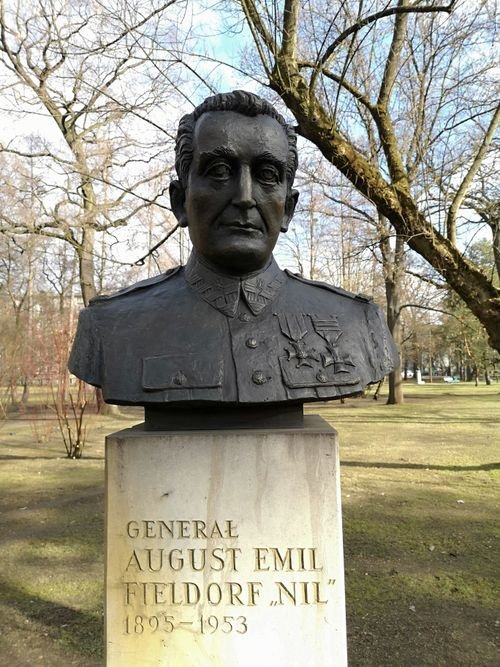
Fieldorf was commander of Kedyw, the sabotage branch of the AK from 1942to 1944. In October 1944, he became the deputy commander-in-chief of AK. After arrest by the Soviets in March 1945 under an assumed name he was sent to a Siberian gulag until his release and return to Poland in 1947. Trusting in an amnesty for former resistance members, he came forward to the communist authorities. The sham amnesty resulted in his arrest in 1950, false accusation of collaborating with the Nazis and execution in 1953 in secret. His family was not told where he was buried.
A cenotaph was placed in in Powązki cemetery in Warszawa in 1972. In 1989, following the collapse of communist Poland, Fieldorf was officially rehabilitated and in 2006 posthumously awarded The Order of the White Eagle.
Wing Commander Stanisław Skalski
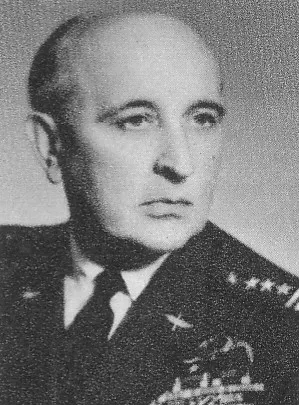
Skalski completed his pilot training in 1938 in Poland and took part in defence of Poland in September 1939, shooting down a total of six German aircraft. He escaped to Britain via Rumania and joined the 501 Squadron of the Royal Air Force before eventually becoming the first Pole to command an RAF Squadron and Poland’s top fighter ace.
He returned to Poland in 1947 and joined the Air Force of the Polish Army. Arrested in 1948, falsely accused of espionage, sentenced to death, but reprieved in 1953. He spent 8 years in prison until 1956, much of it in solitary confinement.
He was reinstated in the Polish Air Force and in 1988 promoted to the the rank of Brigadier General. He was honoured with, amongst others, Virtuti Militari – Golden Cross by Poland and Distinguished Service Order by Britain.
Captain Zygmunt Szendzielarz “Łupaszko”
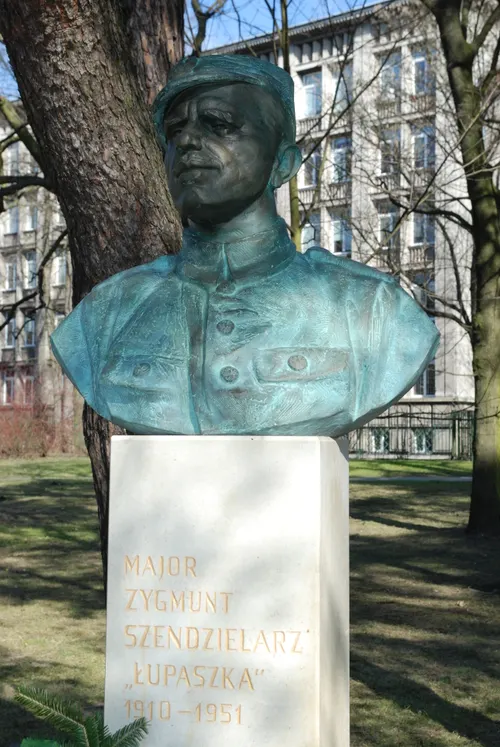
At the outbreak of war, Szendzielarz comanded the 4th Niemen Uhlan Regiment in Wilno in defence against the Soviet invasion. He was captured but managed to escape to Lwów where he joined the AK. He refused to accept Soviet occupation and formed a partisan group, 5 Wileńska Brygada Armii Krajowej (5th Vilnian Home Army Brigade). He led guerrilla resistance against the Wehrmacht and Waffen-SS units as well as Soviet partisans and remained active until the end of the war. When the new communist regime became established, Szendzielarz resumed partisan action based in forests of northern Poland but disbanded his unit when support from the West did not materialise.
Captured in 1948, he was tortured and executed in 1951. His body was hidden in an unmarked grave.
In 2013, his remains were identified; he was given a full military funeral in 2016 with a number of awards including the highest military honour, The Virtuti Militari, V class.
According to post-1989 research, over 50,000 members of the Polish Armed Forces or resistance groups were imprisoned, and several thousand were executed or died in prison between 1945 and the early 1950s. A group known as the “Cursed Soldiers” (Żołnierze Wyklęci) refers to these individuals who continued to resist Soviet rule and were often labelled as “bandits” or “traitors” by communist propaganda.
“To Return To Poland Or Not To Return”– The Dilemma Facing The Polish Armed Forces At The End Of The Second World War. PhD Thesis by Dr Mark Ostrowski