
Aftermath of WWl in Kresy
In 1918, the outcome of the First World War was the independence of Poland from Prussia, Russia and Austro-Hungarian empire after a partition of 123 years. Nevertheless the Eastern border was threatened by Ukrainian nationalists and led to the Polish Ukrainian War between November 1918 to July 1919. Poland won the disputed territories but these remained under threat from the Soviet Union which had emerged from the Russian revolution and Civil War. The Bolsheviks intended to spread their Communist doctrines to the rest of Europe starting with newly independent Poland. Initial Polish successes, With the help of some Ukrainian factions, Polish forces repelled the invaders as far as Kiev but were rebuffed with the Red Army in turn advancing as far as Warsaw. There, Lenin suffered a decisive defeat in what was popularly regarded as the “Miracle of Warsaw”. The war ended with the Treaty of Riga on 18 March 1921 which settled the border between the two nations.
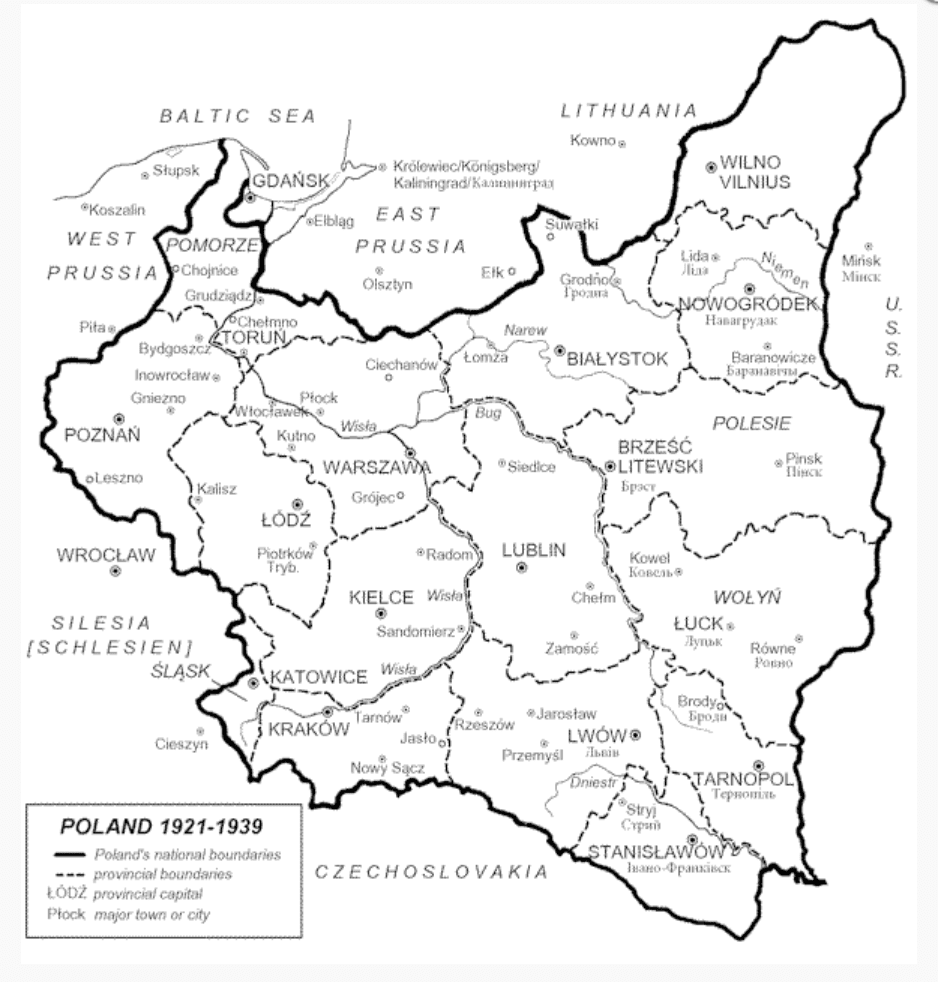
The new state stretched to the east to include the provinces of Nowogródek, Polesie, Wołyń, Tarnopol, and Stanisławów. The major cities were Wilno (Vilnius), Stanisławów (Ivano-Frankivsk), Lwów (Lviv) and Brześć (Brest). These areas became known as Kresy – Borderlands. The area encompassed a population of five million Ukrainians and 150,000 Belarusians 80,000 Russians. In one estimate, only 15% of the population was ethnically Polish. Yet there were 2 million Poles left outside the new borders.
Shortly before the Battle of Warsaw on 7 August 1920, the Premier of Poland, Wincenty Witos, announced that, after the war, volunteers and soldiers who served on the front would have priority in the purchase of state-owned land, while soldiers in receipt of medals for bravery would receive land free-of-charge. On 17 December, the Sejm (Polish Parliament) passed two Acts allowing the demobilised soldiers to apply for land parcels and referred to over 20 powiats (counties) in the eastern voivodeships (provinces) of Poland. Some of the osady/farms (lands awarded to osadnicy – military settlers) were built from scratch, out of the wilderness; others had come from post-tsarist Russian and post-Polish estates. Osadnicy came from all social classes.
However, in reality, there were more applicants than free land and even the recipients of the Virtuti Militari honours had to pay for their plots. Civilians were able to purchase colonised settlements (known as kolonia). The cost of the land itself was to be repaid by settlers five years after the start of the programme.
Osadnicy were expected to take part in the economic and cultural life of these backward provinces and to boost modern methods of farming. Their accomplishment over 18 years was considerable. Not only were the Poles very keen to maintain their Polish culture and traditions, but on their farms they introduced new methods of agriculture, popularised the co-operative idea, encouraged the growth of farmers’ associations. These modern farming methods also proved to be beneficial to the local Ukrainians and Byelorussians, and the relations between the osadnicy and non-Polish locals, particularly at the beginning, were generally amicable.
They also took an active role in the agricultural, social and cultural affairs of their regions. This involvement in local concerns drew the settlers closer to their Ukrainian and Byelorussian neighbours and thus reduced the initial prejudice generated in many cases by the tensions of Borderland politics.
However, economic difficulties of the newly-established state, as well as strong opposition to the idea of the creation of soldier/civilian settlements along the eastern border of Poland, brought this policy to an end in 1923.
Life in pre-war Kresy has been recorded by large numbers of people ranging from the nobility to the peasant and, what is clear from this primary evidence, is that they were in the main extremely enterprising and resourceful, determined to forge a life for themselves and their families, determined to maintain and promote their culture and tradition. A number of accounts were gathered and included in a compendium titled Z Kresów Wschodnich R.P. Wspomnienia z Osad Wojskowych 1921-1940 From The Eastern Borderlands of Poland, Memories of Military Settlements 1921-1940. These have been translated and published on this site.